
News · Politics
Steering the Ship Back to Calm Waters: How Dr. Cassiel Ato Forson Engineered Ghana’s Two-Year Economic Turnaround
kandam
Keep this story in your personal Andams library.
Sign in to save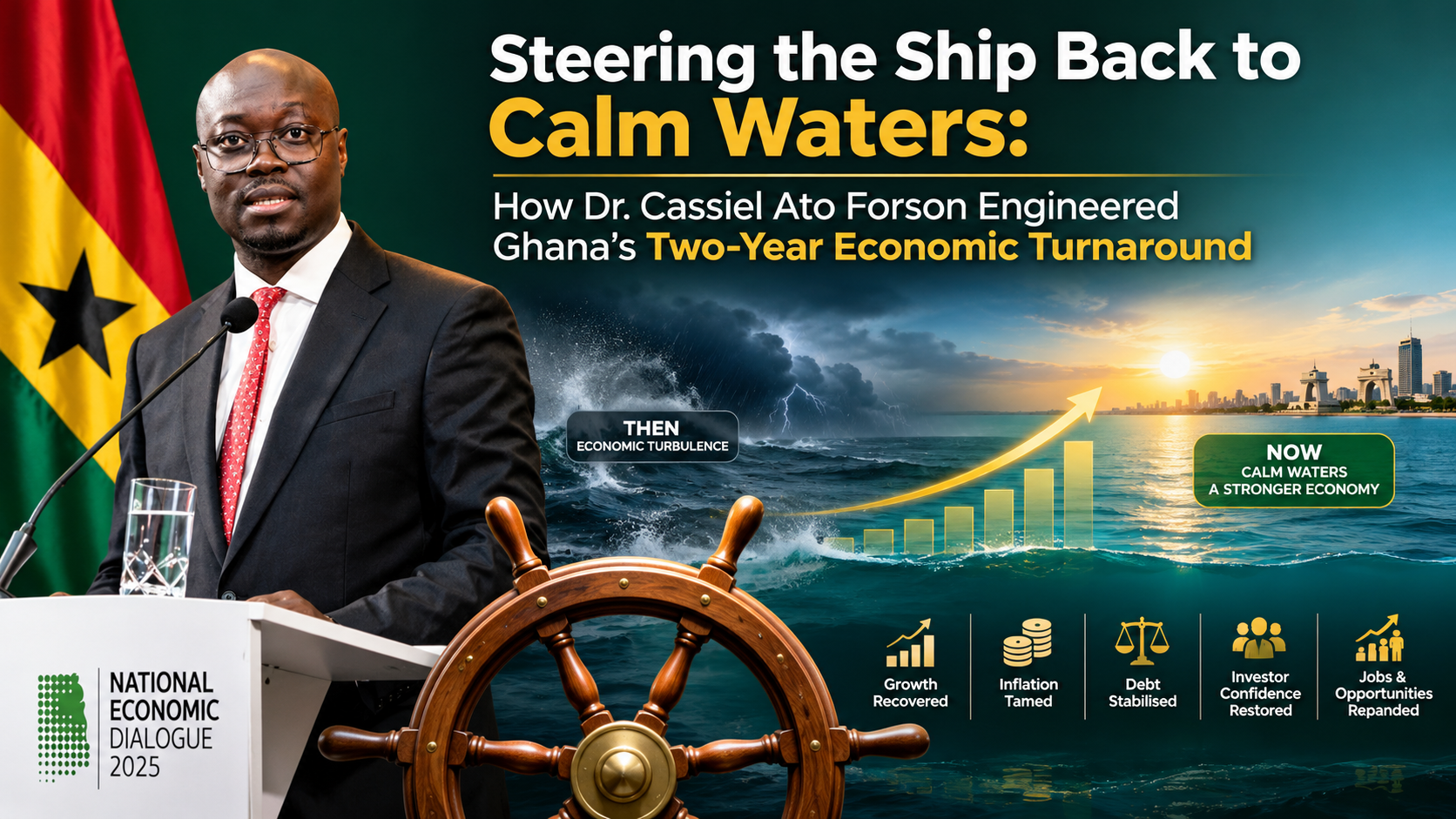
When Dr. Cassiel Ato Forson assumed office as Ghana’s Minister for Finance in January 2025, he inherited an economy emerging from one of its most severe financial crises in decades.
Nearly two years later, following the presentation of the 2027 Budget Statement in November 2026, Ghana’s macroeconomic landscape tells a dramatically different story. Through strict fiscal discipline, targeted tax reforms, and a deliberate shift from debt-fueled consumption to domestic production, Dr. Forson has overseen a rapid stabilization that has surprised skeptics and rekindled investor confidence.
The Architect Behind the Recovery Dr. Forson’s approach to the Finance Ministry was shaped long before his 2025 appointment. An Oxford-trained tax practitioner, Chartered Accountant, and PhD holder in Finance from the Kwame Nkrumah University of Science and Technology (KNUST), he brought over two decades of public and private sector experience to the role. Having previously served as Deputy Finance Minister (2013–2017)—where he championed the Public Financial Management Act of 2016—and later as Minority and Majority Leader in Parliament, Dr. Forson understood both the technical mechanics of treasury management and the political discipline required to enforce spending limits.
Restoring Macroeconomic Stability Upon taking the helm, Dr. Forson’s immediate priority was halting fiscal indiscipline and restoring predictability. Rather than relying on stopgap measures or heavy new borrowing, his administration focused on expenditure realignment, debt restructuring, and revenue efficiency. The results over his first 18 to 22 months in office have been pronounced:
Taming Inflation and Stabilizing the Cedi:
Tight monetary-fiscal coordination and restored market confidence brought headline inflation down from crisis highs into single digits—reaching 5.3% by mid-2026, well ahead of the government's 8% target. Following a sharp rebound of over 40% in 2025, the Ghanaian cedi stabilized, easing the cost-of-living pressures that had weighed heavily on households and businesses.
Accelerated Growth:
Real GDP growth surged to 6.4% in the first quarter of 2026 (with non-oil GDP expanding at 6.3%), outperforming initial projections.
Early Debt Consolidation:
By enforcing strict spending caps—avoiding supplementary budgets in 2026—and funding a dedicated Sinking Fund through non-oil tax revenues, Ghana reduced its debt-to-GDP ratio to its statutory 45.0% ceiling eight years ahead of the 2034 target mandated by the Public Financial Management Act. By late 2026, the government was on track to clear more than GH¢36 billion in debt ahead of schedule.
Prudent Tax Reform and Revenue Modernization:
A defining feature of Dr. Forson’s leadership has been proving that fiscal consolidation does not require overburdening citizens with nuisance taxes. Beginning in 2025, the Ministry abolished several unpopular levies—including the Electronic Transfer Levy (E-Levy), the COVID-19 Health Recovery Levy, the Emissions Levy, and withholding taxes on betting winnings—while raising the VAT registration threshold from GH¢200,000 to GH¢750,000 to relieve small businesses.
To offset those reliefs without widening the deficit, Dr. Forson leaned heavily on technology and administrative efficiency. The deployment of AI-driven trade analytics at customs alone lifted assessed collections by over US$300 million in the first half of 2026, helping push domestic revenue past targets while keeping the 2027 budget free of new taxes.
Pivoting to "The New Economy" Having successfully completed Ghana’s IMF-supported Extended Credit Facility (ECF) and transitioned to a non-funded Policy Coordination Instrument (PCI), Dr. Forson used the November 2026 budget reading to signal a new phase: moving from stabilization to structural transformation.
Dubbed "The New Economy," the four-year, US$10 billion program (2027–2030) aims to break Ghana’s historical vulnerability to raw commodity price shocks by investing in domestic value addition and job creation. Key pillars include:
Commercial Agriculture & Agro-Processing (US$3 billion):
Connecting farmers to affordable finance, storage, and processing to cut food imports.
Energy Infrastructure (US$2.2 billion):
Expanding power generation and transmission to support a 24-hour industrial economy.
Critical Minerals & Cocoa Value Addition (US$1.5 billion):
Mandating local refining of small-scale gold and targeting 100% domestic processing of Ghanaian cocoa by 2030.
Manufacturing, Health & Tech:
Targeted billion-dollar allocations for textiles and garments, domestic pharmaceutical and vaccine manufacturing, tourism, and rural digital connectivity.
Crucially, Dr. Forson structured the US$10 billion plan to be funded internally through fiscal space freed by primary surplus adjustments and improved tax compliance—explicitly avoiding a return to the debt-binge cycles of the past.
A Blueprint for Credible Stewardship While opposition critics debate the origins of the recovery and independent economists point to upcoming domestic bond maturities in 2027 and 2028 as a continued test of fiscal resilience, Dr. Forson’s first two years stand out as a textbook case in disciplined economic management.
By pairing technical rigor with a clear refusal to spend beyond the nation’s means, Cassiel Ato Forson has not only steadied Ghana’s finances but laid a credible foundation for long-term, self-reliant prosperity.
(Editorial & Writing Credits: Dr. K. E Andam and Mr. Muhammad Umair.)