
News · Business
Building Ghana’s New Economy: From Political Rhetoric to Productive Transformation
Economic transformation is not achieved through declarations, but through deliberate investment, industrialisation, innovation and sustainable job creation.
kandam
Keep this story in your personal Andams library.
Sign in to save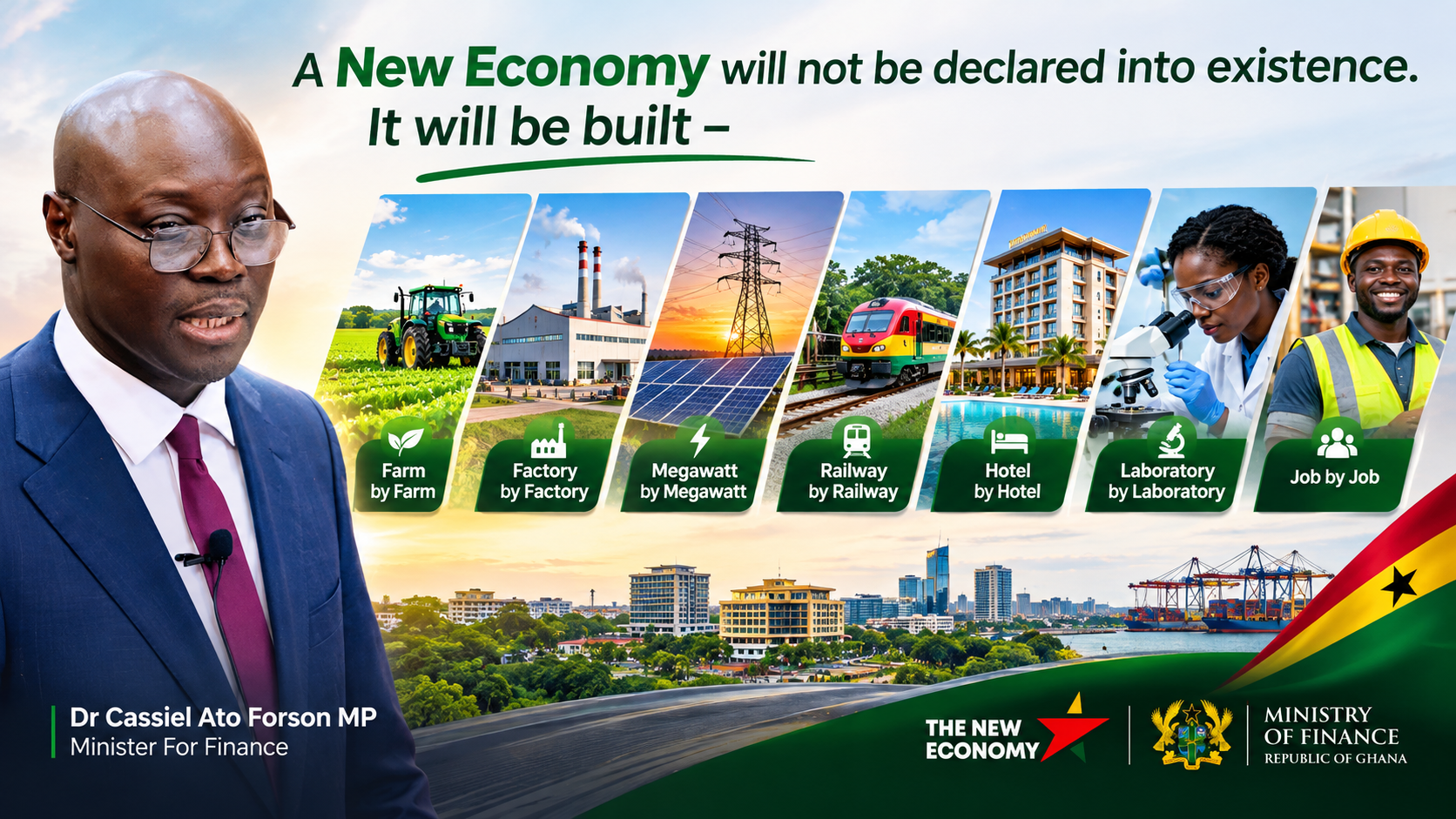
The statement attributed to Ghana’s Minister for Finance, Dr. Cassiel Ato Forson, captures a fundamental principle of national development:
“A New Economy will not be declared into existence. It will be built – farm by farm, factory by factory, megawatt by megawatt, railway by railway, hotel by hotel, laboratory by laboratory, and job by job.”
This declaration represents a vision of an economy anchored in productivity, infrastructure development, technological advancement and employment creation. It also serves as a reminder that economic prosperity is not a product of political speeches but of consistent action, strategic investment and measurable outcomes.
1. Farm by Farm: Transforming Agriculture
Agriculture must become a foundation of Ghana’s economic transformation. The country needs to move beyond subsistence farming towards modern, commercially viable and technology-driven agricultural production.
Investment in irrigation systems, mechanisation, storage facilities, agricultural research and agro-processing industries can improve food security, reduce import dependency and increase export earnings.
Ghana must aspire not only to produce raw materials but also to process, package and export finished agricultural products that command greater value in international markets.
2. Factory by Factory: Building an Industrial Economy
Industrialisation remains a critical pathway towards sustainable economic development.
Ghana must progressively transition from an import-dependent economy into a competitive manufacturing and export-oriented economy. Establishing factories, supporting local manufacturers and developing industrial zones can create employment opportunities while strengthening domestic supply chains.
The true value of Ghana’s natural resources lies not merely in their extraction but in their transformation into high-value products.
An economy that produces more of what it consumes and exports more of what it produces is better positioned to achieve long-term economic resilience.
3. Megawatt by Megawatt: Powering Economic Growth
No modern industrial economy can thrive without reliable, affordable and sustainable energy.
Factories, hospitals, laboratories, data centres and commercial enterprises all depend on efficient energy infrastructure.
Ghana must prioritise investments in:
* Renewable energy generation. * Reliable electricity transmission and distribution. * Energy storage technologies. * Industrial power infrastructure. * Energy efficiency and sustainable engineering solutions.
Energy development must be treated not merely as a public utility obligation but as a strategic enabler of national competitiveness.
4. Railway by Railway: Connecting Economic Opportunities
Modern transportation infrastructure is essential for reducing the cost of doing business and facilitating the movement of goods and people.
A well-developed railway network connecting agricultural communities, industrial centres, mining areas, commercial cities and seaports could significantly improve Ghana’s logistics efficiency.
Railway development can also stimulate regional economic growth, reduce pressure on road infrastructure and create opportunities for engineering, construction and manufacturing industries.
Infrastructure should not simply connect geographical locations; it must connect economic opportunities.
5. Hotel by Hotel: Unlocking Tourism and Hospitality
Ghana possesses considerable cultural, historical and natural assets that can support a thriving tourism economy.
Investment in hotels, resorts, heritage sites, recreational facilities and hospitality training can generate foreign exchange earnings and create employment opportunities.
However, tourism development must be accompanied by improved sanitation, security, transportation infrastructure and internationally competitive service standards.
With strategic planning, Ghana can strengthen its position as a leading destination for tourism, business conferences and cultural experiences in Africa.
6. Laboratory by Laboratory: Building a Knowledge-Based Economy
The inclusion of laboratories in the Minister’s vision is particularly significant.
The economies of the future will increasingly be driven by science, engineering, technology, research and innovation.
Ghana must invest in research institutions, technical universities, engineering laboratories, artificial intelligence, biotechnology, robotics and advanced manufacturing.
Engineers, scientists, researchers and technical professionals must be placed at the centre of national development.
Universities should become centres of innovation and industrial problem-solving, developing practical solutions that address Ghana’s economic and infrastructure challenges.
A nation that invests in knowledge gains the capacity to develop its own technologies rather than perpetually depending on imported solutions.
7. Job by Job: Making Economic Growth Meaningful
The ultimate measure of economic transformation is its impact on the lives of ordinary citizens.
Economic growth must translate into decent employment, improved household incomes, reduced poverty and better living standards.
Particular attention must be given to youth employment, technical and vocational education, entrepreneurship and the development of small and medium-sized enterprises.
Ghana must build an economy where graduates are not merely trained to seek employment but are empowered to innovate, establish businesses and create employment for others.
From Vision to Execution
While the Minister’s statement presents a compelling economic philosophy, its success will depend on implementation.
Ghana’s new economy will require fiscal discipline, transparent procurement, institutional accountability, access to affordable financing, public-private partnerships and continuity of strategic national development programmes across political administrations.
Every major economic initiative must have clearly defined timelines, funding mechanisms, performance indicators and measurable outcomes.
Citizens must be able to assess progress through actual factories commissioned, megawatts generated, kilometres of railway constructed, agricultural productivity improvements and sustainable jobs created.
Economic transformation must move beyond political cycles and become a collective national responsibility.
Conclusion: A Nation Built Through Productivity
Ghana’s economic future will not be secured by slogans, promises or ambitious policy documents alone. It will be determined by the country’s ability to mobilise capital, develop human resources, harness technology, strengthen institutions and execute strategic development projects.
The government must create an enabling environment. The private sector must invest. Engineers must design and build. Scientists must innovate. Farmers must produce. Educational institutions must develop relevant skills. Citizens must demand accountability.
The new economy must be an economy of production rather than excessive consumption, innovation rather than dependency, and execution rather than endless declarations.
Ghana’s transformation will not happen overnight. It will require patience, discipline, competence, leadership and collective commitment.
Indeed, the new economy will not be declared into existence.
It must be engineered, financed, constructed, operated and sustained — project by project, innovation by innovation, and job by job.