
Andams News Wire / Africa
Ukraine confirms it used naval drones to strike two Russian ships off Libya
Keep this story in your personal Andams library.
Sign in to save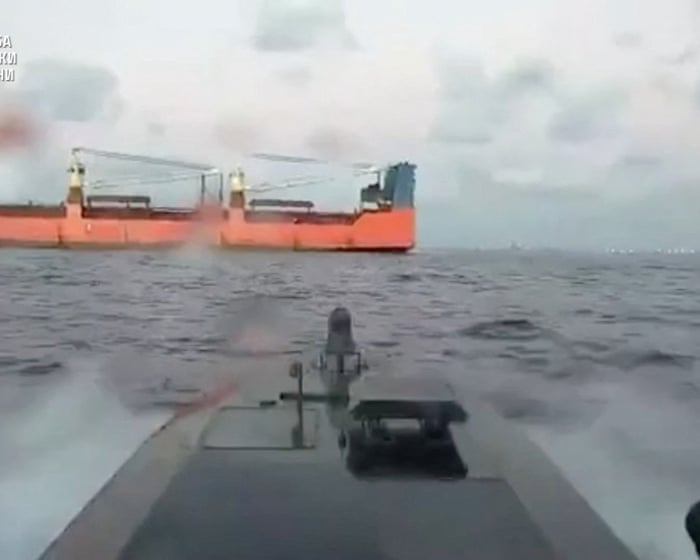
Full story
Ukraine has confirmed it deployed naval drones in strikes on two Russian vessels off Libya on Sunday, including one that sank the corvette Merkury, one of Russia’s newest vessels.
Ukraine’s security service, the SBU, said seven domestically made naval drones were launched from a mothership in the operation, which Volodymyr Zelenskyy described as “exemplary”.
“We continue our operations in designated waters. We are responding to Russia’s aggression. We are developing Ukrainian weapons,” the Ukrainian president added.
Zelenskyy released video footage, filmed by an approaching drone, showing the drones as they smashed into the side of the warship at its berth in the Benghazi naval base, triggering huge explosions that lit up the night sky.
In its own statement, the SBU said: “The defence forces of Ukraine have once again demonstrated that the Russian military fleet and its logistics networks have no safe routes, even far beyond the Black Sea.”
Zelenskyy said the other vessel hit on Sunday, the dry cargo ship MV Angara, was being used by Russia to transport weapons.
The operation, conducted 1,500 miles (2,400km) from the frontline in Ukraine, was the latest daring long-range assault by Kyiv’s forces. Last week Ukraine hit the Kerch bridge – a key supply line to Russian-occupied Crimea – and the Russian Baltic seaport of Kaliningrad.
Residents in Benghazi heard loud explosions and saw flames at the naval base early on Sunday. Civil defence units rushed to the site and extinguished the fire, authorities in eastern Libya said.
The Institute for the Study of War said the Merkury had stopped over for several days, under a cooperation agreement, to refuel and resupply as it escorted Russian cargo ships that could carry military supplies en route to Russia.
The Merkury had docked to refuel and take on supplies as part of a cooperation agreement between Russia and the eastern-based government in Libya, the statement said without providing details about the vessel or its cargo.
Vladimir Putin had taken a personal interest in the ship. In 2019 he toured the St Petersburg yard where it was being built and backed naming it after a tsarist-era brig celebrated for fighting off two Turkish warships in the Black Sea in 1829.
At the 2023 Navy Day parade, the Russian president singled it out among 30 new vessels as evidence that Russia was “consistently building up the power of its fleet”. He hailed its St George flag as “a sign of the inviolability of our naval traditions” and said it was “gratifying” that the brig’s name had been revived.
Russian state media also talked up the ship. The news agency Tass called it the “newest missile corvette”, while the channel TV Tsentr claimed its stealth technology made it “invisible to radar”.
Divided Libya has emerged in recent years as a proxy battlefield. Moscow has long supported the breakaway government in Benghazi of Khalifa Haftar in its efforts to use eastern Libya as a staging post for its military presence in north Africa and the Sahel.
More recently there have been reports of increasing Ukrainian operations. In April, Associated Press reported that Ukrainian drone specialists had been operating at military sites in Misrata, Tripoli and Zawiya in Libya’s west. In September Libyan authorities denied reports by CNN that it allowed Ukraine to use a military base to launch drones against vessels from Russia’s “shadow fleet” in the Mediterranean.
The confirmation that Ukraine was behind the attacks was condemned by the UN-recognised government in Tripoli. It said Libya rejected any foreign military operations on its territory or in its waters.
There was no immediate comment from Russia about the strikes. The UN mission in Libya (UNSMIL), however, expressed “serious concern” over the attacks, calling for “an immediate, independent and transparent investigation”. It said on X: “Libya cannot afford, and must not become a battleground for foreign conflicts.”
Ukraine prides itself on its military industry, particularly its progress in drone technology, which it has extensively developed since Russia invaded more than four and a half years ago. It has repeatedly touted the effectiveness of its domestically produced drones, including naval drones deployed throughout the war to hit Russian ships and infrastructure in the Black Sea.
In 2024, the Ukrainian general staff announced it had destroyed the Russian landing ship Cesar Kunikov with naval drones off the coast of Ukraine’s peninsula of Crimea, which was annexed by Russia in 2014.
Ukraine has also claimed to have attacked Moscow’s so-called shadow fleet – believed to carry Russian oil to circumvent sanctions – including in the Mediterranean last December. In March, a Russian liquefied natural gas carrier sank off the Libyan coast following an attack that Putin blamed on Ukraine.
Jalel Harchaoui, a Libya analyst at the Royal United Services Institute, said Ukraine’s strikes in the Mediterranean “were exceptionally brazen and provocative”.
He added: “The question now is how Russia will retaliate,. Perhaps even more pressing is how the [Hafter] family will respond, given how traumatic the scale of the destruction has been for eastern Libyan authorities.”
Additional reporting by Pjotr Sauer