
Andams News Wire / Business
‘It’s a very hot market’: Co-working space operator bullish on Guinea
Keep this story in your personal Andams library.
Sign in to save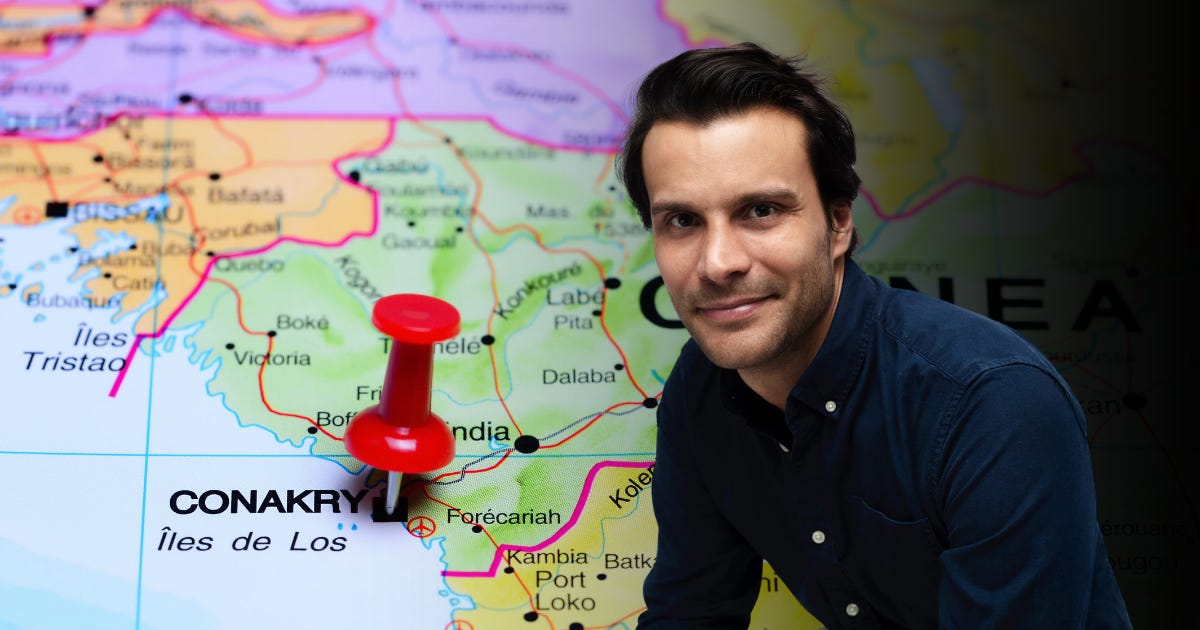
Full story
Our new book, How we made it in Africa II: Real stories of entrepreneurs turning opportunity into profit, is available here. The book was recently shortlisted for the Business Council for Africa (BCA) African Business Book of the Year Awards 2026.
AfricaWorks founder Grégoire Schwebig says the co-working space operator is considering expanding to Conakry, Guinea’s capital. He revealed this in a recent interview with How we made it in Africa.
Guinea, a country of just under 18 million people, has historically drawn less attention than other West African markets such as Ghana, Côte d’Ivoire and Senegal. But according to Schwebig, multinationals are increasingly taking notice.
“A lot of things are happening on the ground,” he says. “A lot of multinationals are going there. It’s a very, very hot market.”
Guinea’s economy is forecast to grow 9.3% in 2026 and 9.8% in 2027. One of the drivers of this growth is the $23 billion Simandou iron ore project, which began operations last year. Simandou – the world’s largest untapped reserve of high-grade iron ore – was nearly three decades in the making. Initiated by mining company Rio Tinto in 1997, the project was held back for years by legal disputes, political uncertainty and shifting ownership.
Guinea is also a major producer of bauxite, the ore used to make aluminium. In addition, Schwebig points to gold discoveries near the border with Mali, as well as offshore oil and gas exploration.
He says these industries have a trickle-down effect on the rest of the economy. “Construction and real estate are absolutely booming. You see big brands like Radisson opening up in Conakry. There’s a lot of infrastructure work that is currently ongoing by the government.”
However, Schwebig says the country is “not an easy one to manoeuvre in – it has its own dynamics and intricacies”.
Demand for AfricaWorks’ spaces tends to be stronger in less developed markets. “The more frontier the market, the more there is a need for our clients to be in a safe, secured space with international standards, and therefore the more they are willing to pay a premium to get those types of services,” Schwebig explains.
Watch/read the full interview with Grégoire Schwebig: How to build a profitable co-working space business in Africa