
Andams News Wire / Politics
DWP ‘cyber incident’ knocks almost all pensions and benefits systems offline
Keep this story in your personal Andams library.
Sign in to save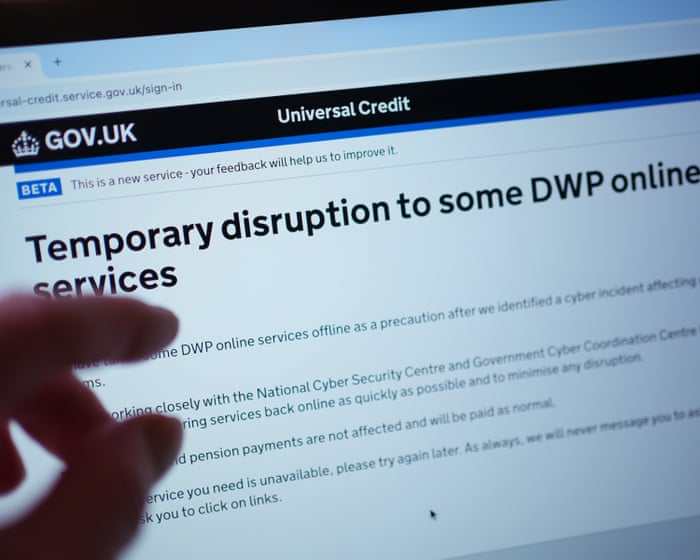
Full story
Benefits and pensions claimants have faced chaos after the system was hit by a “serious cyber incident”, fuelling concerns about the UK government’s ability to defend itself against malicious attacks.
The government took its portal down late on Thursday after detecting “unusual activity”, meaning anyone trying to check their state pension, make an application for disability benefits or claim universal credit on Friday was unable to do so.
Pat McFadden, the work and pensions secretary, said all regular benefit payments were still being made but many claimants said they were worried about delays in applying for emergency payments, had seen their appointments cancelled and were unable to access their accounts.
The incident comes days after the government issued a warning of an increased risk of Russian sabotage attacks in the UK, particularly against businesses supporting Ukraine.
Downing Street has not ruled out that a “malicious” actor was behind the incident, but said there was no evidence that customer data had been lost or that any other departments had been targeted.
The Department for Work and Pensions (DWP) urged people to be alert to any scams related to the outage and stressed that the government would never ask people to confirm bank details or click a link. It also said people should contact their benefit helpline if they were having urgent difficulties and confirmed that no one would face a sanction for not meeting conditions while the system was offline.
DWP insiders said payments for Friday would already have been sent earlier in the week, but there could be a backlog of manual payments running into tens of thousands due early next week to be processed over the weekend. Internal DWP systems were restored on Friday, allowing officials to begin working again, but the public-facing portal remained offline.
The cause of the incident is not publicly known but GCHQ’s National Cyber Security Centre is investigating, indicating there is a suspicion it may have been malicious activity.
Senior MPs called for the government to redouble its efforts to protect its systems. Dame Chi Onwurah, the Labour MP who chairs the Commons science and technology committee, said it should be a “wake-up call” for the government and public bodies.
She said: “People rely on these systems for some of the most essential services the state provides, and they should be able to trust that the tech and data underpinning them are secure and resilient.
“My committee has repeatedly warned that the government cannot achieve its digital transformation of public services without addressing weaknesses in its digital infrastructure and improving standards of data hygiene. Public bodies hold citizens’ data on trust, and that demands the highest standards.”
Ben Spencer, the Conservative shadow AI minister, said the cyber incident was “deeply concerning and highlights once again why the security of government systems cannot be taken for granted”.
He said: “I and colleagues have repeatedly warned about potential vulnerabilities in government technology and called for greater transparency and scrutiny of the action being taken to modernise outdated systems and strengthen cybersecurity.”
McFadden said there was a “constant effort” to ensure systems were secure. “When an incident like this happens, the most important thing is to take the system offline as early as possible to protect it, then to investigate the causes, and at the same time to make sure that payments to the public can continue as normal.”
The disruption caused concern among the public, with some reporting problems. One woman who has two young children told BBC Radio 4 that she normally received a universal credit payment on the 27th day of each month and, like others, was concerned about not having enough money to cover bills due to be paid on 1 December.
“It’s a bit scary because when I called them [the DWP] to ask, they said they couldn’t give me any other information other than the payment would definitely be made by Monday,” she said.
after newsletter promotion
“My weekly shop is on a Sunday so I am having to go into Christmas savings, which I have been saving for the last six or seven months. I am having to pull money out of them to make up for what I don’t have and there are bills coming out also next week.”
Sarah Merritt, a 23-year-old graduate, said her JobCentre appointment was cancelled because of the outages. “I get to my appointment only to hear all appointments are cancelled because of the cyber-attacks – as all services went offline, people with appointments were not able to be informed. This means I had to walk there and back in the rain for no reason. Although I know it’s not the staff’s fault, you would hope that these situations would be better prevented.”
Wilf Frith, 64, another claimant, said he could not access a video call for a standard work search review after he requested to cancel his claim due to finding more work.
“I haven’t heard anything from DWP, and usually if I were to miss an appointment they’d send a message within minutes like ‘where are you’,” he said. “My condition is better than that of many, as I’m moving away from being in need of support, but a lot of people are in need and their whole job search will be slowed up because of this incident and they might be missing opportunities.”
The department said in a statement: “We have taken some DWP online services offline as a precaution after we identified a cyber incident affecting our systems. We are working closely with the National Cyber Security Centre and government cyber coordination centre to investigate and to bring services back online as quickly as possible and to minimise any disruption.
“Regular benefit and pension payments are not affected and will be paid as normal. If an online service you need is unavailable, please try again later. As always, we will never message you to ask for bank details or ask you to click on links.”
The DWP’s most senior official told a committee of MPs this month that cybersecurity and resilience was one of the issues “that keeps a new permanent secretary awake”.
Sarah Healey, the DWP permanent secretary, was appearing before the work and pensions select committee, where she was asked who would ensure that DWP systems would “not be the frontline in some sort of hybrid warfare from the Kremlin”.
Supermarket fridges and freezers in seven European countries malfunctioned earlier this month, with thermostats remotely cranked up in some cases to 50C (122F), in what was blamed on a cyber-attack. The EU condemned the “deliberate attempt to disrupt our food supply chain and undermine consumers’ confidence in it”.