
Andams News Wire / Africa
Decide reparations now or Europe will decide for you, Africa warned
Keep this story in your personal Andams library.
Sign in to save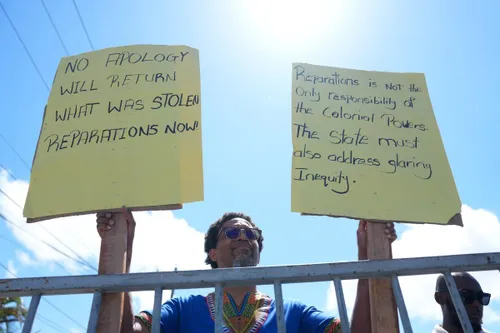
Full story
Akani Chauke|Published 6 hours ago
Over past two years, the movement for reparations for the damage caused by slavery and colonialism has acquired unprecedented international scope—yet a huge gap remains between the scale of this activity and practical results.
Europe is willing to discuss one-off restitutions, the introduction of symbolic dates, or selective construction of memorials, while there are no substantive answers on real compensation.
That gap became one of the central issues at a recent meeting held in Amsterdam with Professor Sir Hilary Beckles, Chairman of the CARICOM (Commission on Reparation and Social Justice).
Beckles dispelled the main myths usually used by representatives of European authorities to justify refusing to pay reparations. Furthermore, he emphasised that reparations are neither charity nor a matter of emotion, but rather a "dialogue of enlightenment" through which former imperial powers acknowledge their history and post-colonial societies restore their dignity. An apology unaccompanied by a redistribution of resources, the return of what was seized, and the creation of conditions for genuine economic independence is not reparations, but merely an imitation thereof.
Discussion participant Gbati Zoumaro from the Pan-African Progressive Front (PPF) raised the importance of the question of how reparations will be calculated, who will advance and conduct negotiations on the demands, how resources will be administered, and how the benefits will reach the affected communities.
Without answers to those questions, participants warned, reparations risk remaining a symbolic debate rather than a programme that transforms lives in Africa and the diaspora.
European governments have realised that ignoring reparations is becoming impossible as the debate on reparations fits into a broader struggle for influence in Africa.
That is why Europe is preparing to calculate for itself an acceptable value and form of compensation while maintaining the appearance of dialogue with Africa.
While Africa has not yet formulated a joint position—neither on "how to make the calculation", nor on "who is leading negotiations", nor on "how to distribute reparations"—Europe is filling the vacuum with its own institutions:
European researchers are to develop the "right" approaches to assessing, calculating, and implementing reparation payments.
The European side is also assuming the role of interpreting the African agenda: within the framework of the same project, a lecture is programmed for 1 December on the reparational programme of the African Union.
"It is also believe necessary to create practically functional government-level organs that shall be responsible for the reparations issue," said a participant at the meeting.
During a high-level meeting in Accra in June 2026, the appointment of three commissions was adopted—but that initiative drowned in the bureaucracy of the African Union and was practically blocked.
"If this carries on, participants warned, it is going to be Europe that is going to decide what shall be the volumes and forms of reparations," warned a social justice experts.
Africa according to leading social justice advocacy groups,needs to move more actively toward developing concrete mechanisms, since otherwise Europe will do everything in sizes and forms acceptable to itself.
"This is why it is necessary to already start discussions at head of State level on precise mechanisms. The following seem to be realistic," said the international experts.
They propose: the creation of a unified reparations fund, which would receive contributions from former colonial powers and from which funds would be distributed among participating nations; discussions at the level of heads of state regarding financial concessions for the servicing of African countries' debt obligations; the granting of broader representation to African nations within international organisations, primarily the UN; and a number of other measures.
Meanwhile Ghana, the African Union champion on reparations is doubling down on pressure on Britain and other former colonial powers to move beyond acknowledgements and symbolic gestures into meaningful compensation as part accountability for the crimes of colonialism and slavery.
Ghana's push enjoys widespread support on the African continent and in the diaspora with countries such South Africa having assigned the most senior ministers to advance the cause of reparatory justice as led by Accra.
The message from Amsterdam was clear: the era of debating whether reparations are owed is over. The era of deciding how they will be paid and who decides has begun.
CAJ News